


 Subscribe to Main Streets on YouTube
Pleasant Cities:
Mount Pleasant and Pleasant Prairie
Mount Pleasant and Pleasant Prairie, Wisconsin sit along the southeastern edge of the state, just north of the Illinois border, forming a key corridor between Milwaukee and Chicago. Guided by John McGivern, this episode of Main Streets explores how these neighboring communities function together—less as traditional downtowns and more as a working stretch shaped by transportation, agriculture, industry, and everyday life along Interstate 94.
The episode frames Mount Pleasant and Pleasant Prairie as places defined by movement. Long before modern highways, the area developed as agricultural land and as part of the Green Bay Trail, a historic mail route connecting Green Bay and Chicago. That early role established the corridor as a place of passage and exchange, a pattern that continues today through constant north–south travel. One of the most recognizable landmarks along this route is Pleasant Prairie Premium Outlets, a retail center with 90 stores across 140,000 square feet that many travelers know by sight from the highway.
Local history comes into focus at the Pleasant Prairie History Museum, where the episode revisits the 1911 explosion at the Laughlin and Rand Powder Company. When roughly 260 tons of gunpowder and dynamite detonated, nearly every building in the town was flattened. Because the plant was closed at the time and spread across hundreds of acres, only three lives were lost, but the event permanently reshaped Pleasant Prairie and remains a defining chapter in its history.
Food and family tradition anchor the corridor at Mars Cheese Castle. Founded in 1947 by Mario and Martha Mars, the business grew from a butcher’s background into a long-running cheese and sausage operation. The castle-style building opened in 2011 and expanded in 2017, reflecting both a family connection to an ancestral castle in Italy and a commitment to hospitality and Wisconsin-made products that spans generations.
In Mount Pleasant, the episode turns to Anarchy Acres, a working farm focused on growing food for direct consumption. Vegetables and heritage wheat varieties—types grown in Wisconsin during the 19th century—form the backbone of the operation. Wheat serves as the farm’s primary crop, connecting agriculture directly to bread and pizza made from the harvest, while miniature donkeys handle plowing and daily work.
Agriculture continues at Apple Holler, an orchard with 30,000 trees across 78 acres producing apples, peaches, and pears. Open year-round, the orchard highlights how farming remains part of daily life in the region rather than a strictly seasonal activity.
Large-scale culture and industry round out the picture. The Bristol Renaissance Faire brings thousands of visitors to its 30-acre grounds with multiple stages and performers, while Pleasant Prairie’s strategic location has drawn major logistics and manufacturing operations, including a 1.5 million–square-foot Uline distribution center. In Mount Pleasant, a manufacturing facility produces concrete pumps used in construction projects across the Americas.
Together, Mount Pleasant and Pleasant Prairie emerge as a working corridor—where farms, warehouses, performance spaces, and retail coexist, and where movement itself has long shaped the character of the place.
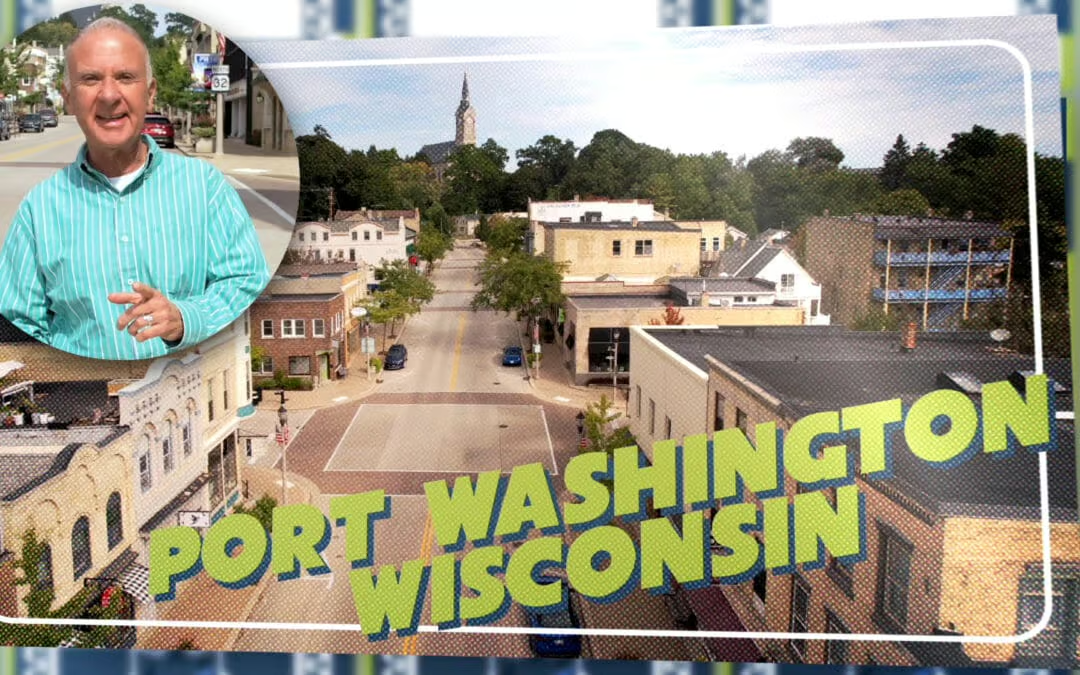
Port Washington, Wisconsin
Along the shores of Lake Michigan, Port Washington blends maritime history, local craftsmanship, and small town community, as John McGivern explores the people and businesses that give the city its character.

Ames, Iowa
Ames, Iowa is a vibrant college town where innovation, education, and community come together, as John McGivern explores its blend of engineering, local businesses, and hands-on experiences that shape the city’s evolving identity.

Walkers Point, Milwaukee
Walker’s Point in Milwaukee is a historic neighborhood where industrial roots and cultural diversity shape a vibrant community explored by John McGivern, highlighting its evolution into a hub for food, small businesses, and Latino heritage.