


 Subscribe to Main Streets on YouTube
Crown Point, Indiana
centers its identity on a classic town square anchored by a courthouse that keeps showing up in the town’s stories—civic, quirky, and occasionally notorious. John McGivern starts by placing Crown Point on the map: a growing community of about 35,000 people, about an hour south of Chicago and about two hours north of Indianapolis, with Interstate 65 running right by.
The episode connects today’s walkable square to the town’s earliest chapter through Solon Robinson, described here as Crown Point’s founder, postmaster, general-store operator, and local author. Robinson arrived in 1834, wrote about the prairie landscape he found, and even explained the name “Crown Point” as a high ridge—a “natural crown above the lowlands”—paired with a hope that the place would “rule this region in justice and civility.” The town’s growth is traced to a practical timeline: farming, lumber, railroads, and a location that benefited from proximity to Chicago and Gary.
From there, the episode leans into one of Crown Point’s best-known legends at the Old Lake County Jail and Sheriff’s House. Guide Sandy Boyd explains how the home and jail were built side by side, expanded in 1908 and 1929, and how the Dillinger story plays out locally—complete with competing accounts of how he got a gun, the decision to move him to the first floor, and the March 3rd escape that escalated into a federal case once a stolen car crossed state lines.
Back at the courthouse, another surprising chapter emerges: from 1915 to 1940, couples came not for trials, but for quick marriages. Crown Point’s courthouse earned the nickname “Marriage Mill” because licenses were cheap and there was no waiting period, drawing hundreds of couples each year—including Rudolph Valentino and Cassius Clay (Muhammad Ali). The courthouse itself is introduced as an 1878 landmark now used for weddings and events, with restored-and-repurposed spaces like a ballroom and a full-size courtroom upstairs, plus shops in the lower level.
Beyond the square, the episode samples working Crown Point: gem cutting and online sales at a local jewelry business, art in a 1927 service station at J Moto Gallery, a look at the city’s oldest house (built in 1846), and a neighborhood known as “Ruffle Shirt Hill,” where the Root Mansion (1892) reflects lumber-era wealth. The day rounds out with stops for mead and cider, a family-run landscape supply and garden center founded in 1948, the Crown Point Sports Complex with 10 softball diamonds and a dome for colder months, and an ice cream shop serving rotating flavors—where corn ice cream is the top seller.

Port Washington, Wisconsin
Along the shores of Lake Michigan, Port Washington blends maritime history, local craftsmanship, and small town community, as John McGivern explores the people and businesses that give the city its character.

Ames, Iowa
Ames, Iowa is a vibrant college town where innovation, education, and community come together, as John McGivern explores its blend of engineering, local businesses, and hands-on experiences that shape the city’s evolving identity.
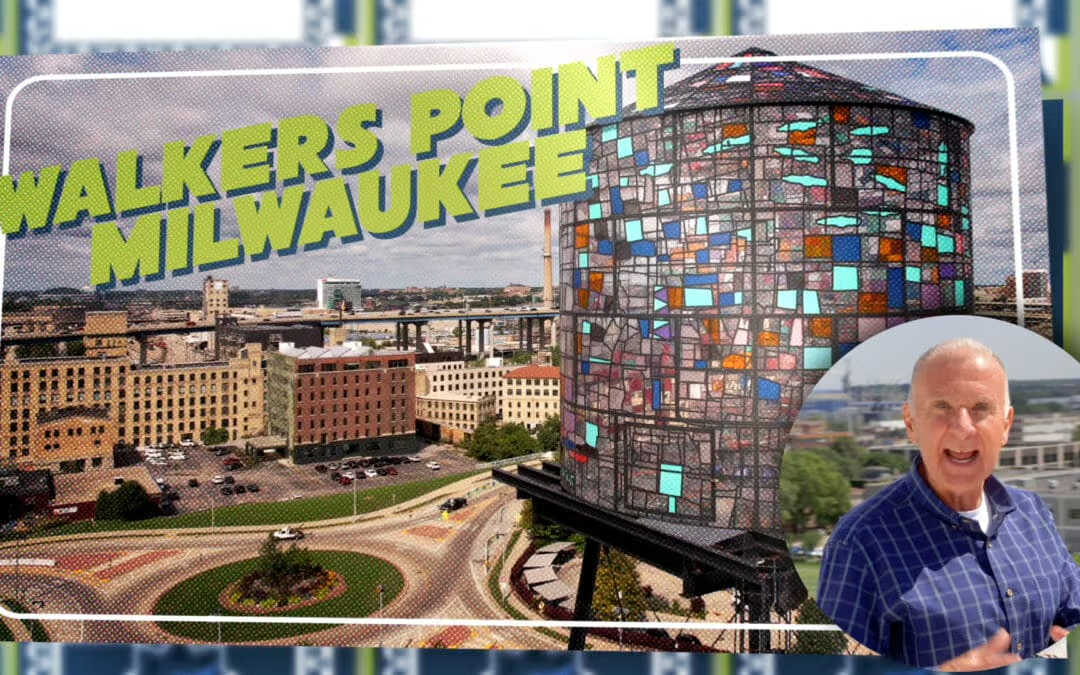
Walkers Point, Milwaukee
Walker’s Point in Milwaukee is a historic neighborhood where industrial roots and cultural diversity shape a vibrant community explored by John McGivern, highlighting its evolution into a hub for food, small businesses, and Latino heritage.